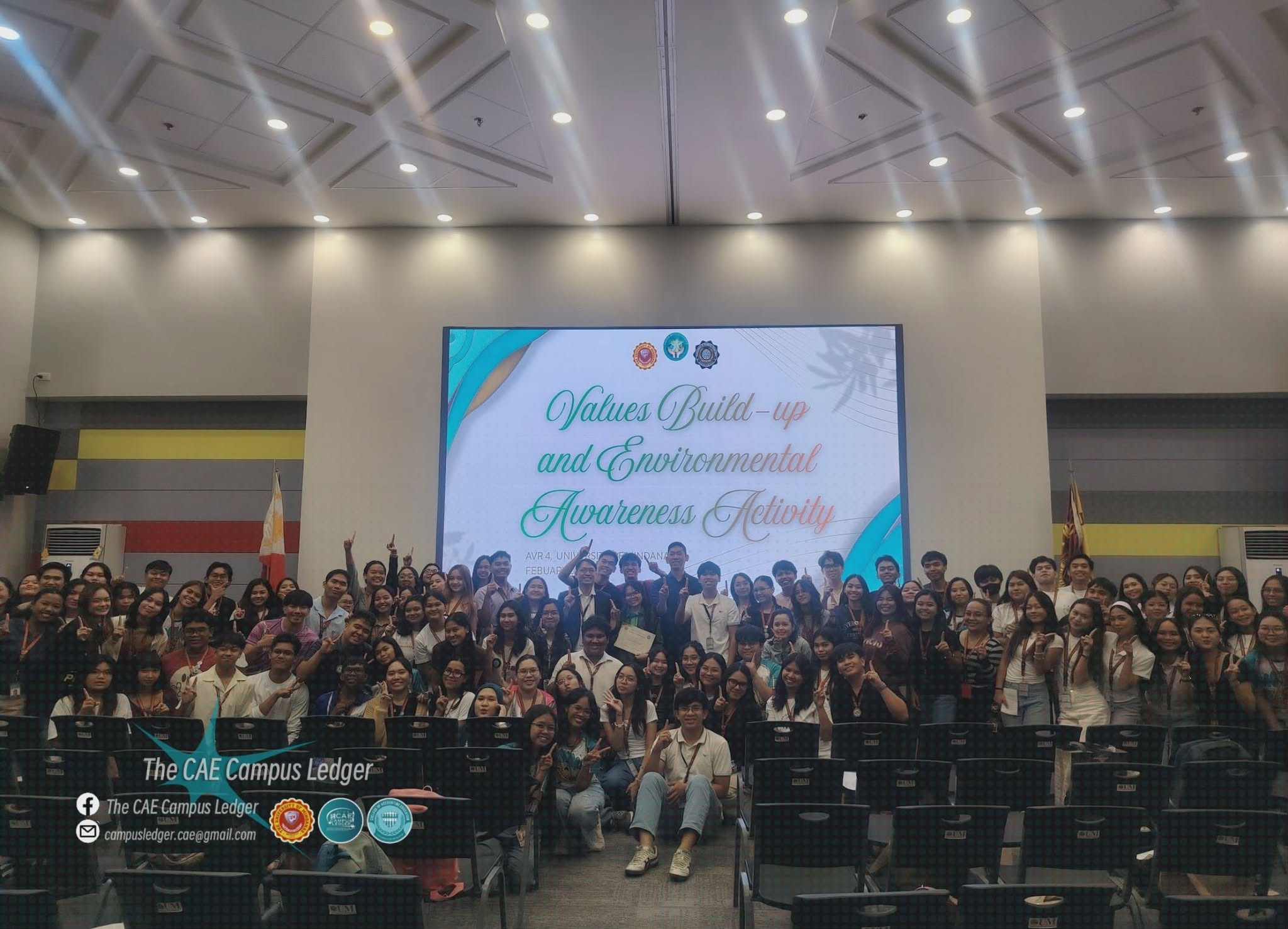
𝐅𝐄𝐀𝐓𝐔𝐑𝐄 | 𝗢𝗻 𝗧𝗶𝗺𝗲, 𝗢𝗻 𝗣𝘂𝗿𝗽𝗼𝘀𝗲: 𝗗𝗶𝘀𝗰𝗶𝗽𝗹𝗶𝗻𝗲 𝗮𝗻𝗱 𝗥𝗲𝘀𝗽𝗼𝗻𝘀𝗶𝗯𝗶𝗹𝗶𝘁𝘆
Time rarely waits—and on February 7, 2026, CAE students of the University of Mindanao realized how crucial every ticking second can be. The Values Build-Up Program Session and Environmental Awareness Activity, held at AVR 4, UM Matina Campus, brought two timely talks that made students reflect on how they use their time and on how they care for the environment around them. The session started with “Young Leaders for the Earth: Taking Responsibility Today for a Sustainable Tomorrow,” delivered by Ms. Richelyn C. Dumdum, who discussed environmental issues commonly observed in communities and universities. She presented concerns such as improper waste disposal, pollution, climate change, and overconsumption of resources. To address these, Ms. Dumdum presented environmental solutions at different levels. Global efforts like the UN Sustainable Development Goals and international climate agreements, national environmental laws and waste management programs, and local initiatives such as clean-up drives and waste segregation. She also highlighted University of Mindanao’s green initiatives, including tree growing and reforestation, waste segregation programs, sustainable campus gardening, energy-efficient operations, and environmental awareness campaigns. An activity on environmental idea generation challenged students to propose solutions to land pollution in their own communities. The main focus of the program, however, was “Time Is Up: Becoming Mindful of My Personal Clock,” led by Sir Emmanuel Driz, CPA, MPA, which resonated strongly with students due to its honesty and relevance. Through a short self-assessment activity, students identified their time-management personality, categorized into five types. Sir Driz first discussed the Oblivious Sloth, described as students who are chronically late, resistant to alarms, and largely unaware or unconcerned about deadlines. These students often rely on excuses, underestimate time, and believe productivity happens best at the last minute. According to Sir Driz, this type reflects a lack of awareness, making punctuality and responsibility difficult to practice. Next was the Anxious Turtle, students who genuinely care and feel guilty about being late but continue to fall behind. They move slowly, overprepare, and plan based on ideal scenarios rather than reality. While they are more aware than the sloth, Sir Driz emphasized that guilt alone cannot improve time management and often leads to stress and burnout. Then, the Reactive Bear represents students who function well only under pressure. They respond aggressively to urgent deadlines but lack consistency and long-term planning. Although capable of producing results, their dependence on stress makes their habits unsustainable over time. Moving on, the Eager Dog was described as enthusiastic and willing but easily distracted. These students start tasks with energy yet struggle to finish them due to poor focus and lack of structure. Without discipline, their motivation quickly fades. Finally, Sir Driz introduced the Disciplined Eagle, the ideal model of time management. This type is proactive, realistic, and consistent, valuing preparation and awareness over pressure. The eagle plans ahead, respects deadlines, and understands that discipline is the foundation of productivity. To help students move closer to the disciplined model, Sir Driz shared practical strategies such as creating artificial urgency, setting non-negotiable alarms, using visual timers, preparing materials the night before, adding time buffers, and choosing progress over perfection. Through a personal story about procrastination during his graduate studies, he emphasized how delayed action can lead to long-term academic consequences. Before the program ended, Sir Driz left students with a reassuring reminder: the personality they recognize in themselves today is not something they are stuck with forever. These “spirit animals” do not define who they are, but simply show where they are starting from. Each student is uniquely diverse, carrying different traits at different moments, and growth is always possible. What matters most is the willingness to become better, one habit at a time. The initiative aligns with United Nations Sustainable Development Goal 4: Quality Education, which promotes lifelong learning, self-discipline, and responsible citizenship. The program reinforced education as a foundation for personal growth and sustainable development. When you begin to ask yourself how you can improve and become better, Sir Driz said that the response is always simple and constant as “the answer lies in your hands.” 🖋️&📷 Joseph Niño Estrella 💻 Carmella Kaye Alave